The Weaponization of Economic Interdependence: How States Are Rewiring Globalization
The article examines how states are transforming economic interdependence into strategic leverage by controlling key nodes in technology, finance, and supply chains, leading to a reorganization of globalization around security concerns and increased political management of economic networks.
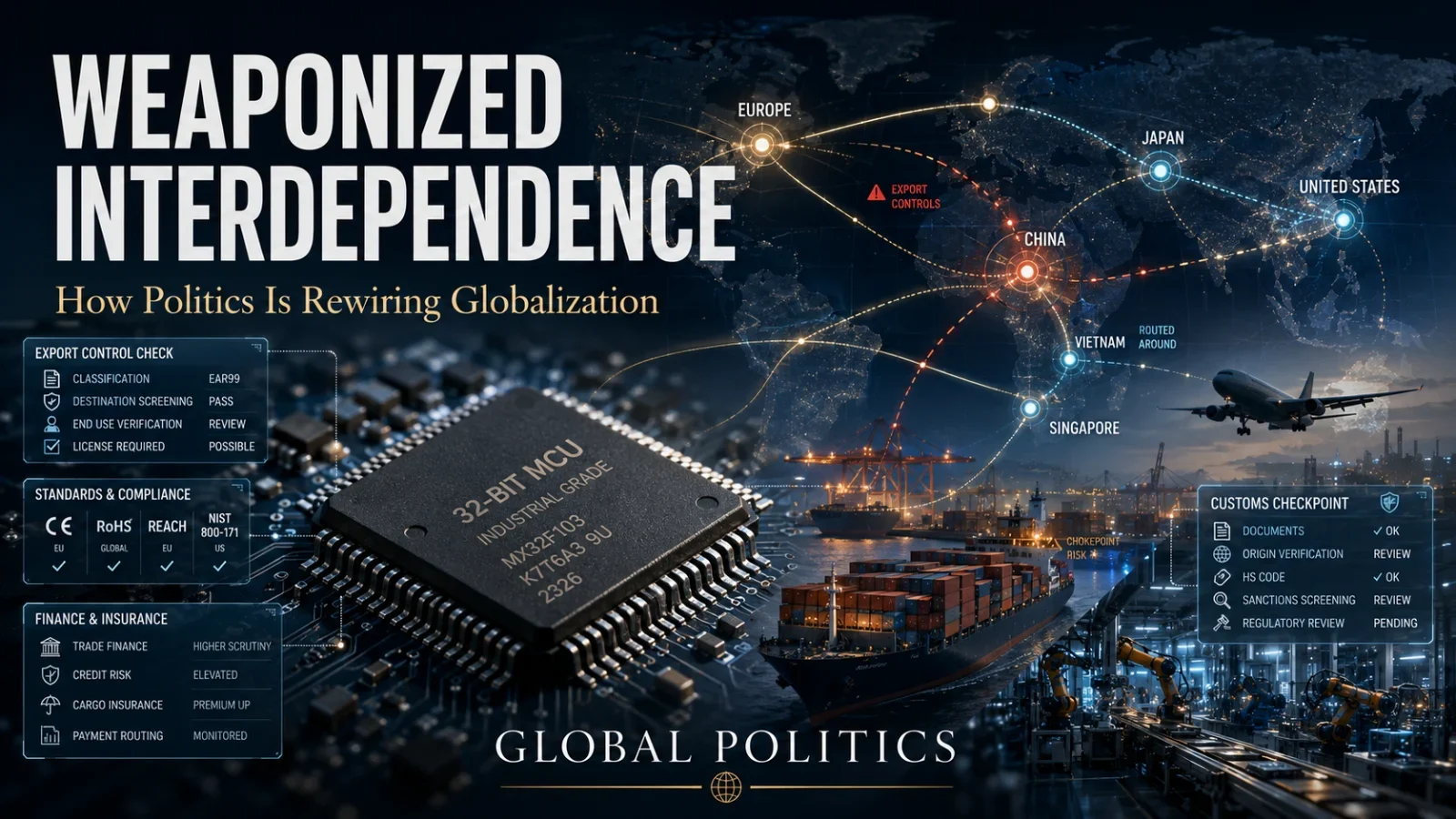
A European manufacturer of industrial sensors receives notice that its Japanese supplier can no longer ship a critical microcontroller. The component itself is unremarkable, yet it contains a firmware library whose design traces back to a U.S. university patent. Compliance officers in three jurisdictions must now approve the transaction. The shipment is rerouted through a new assembly hub in Vietnam, insured by a Singaporean syndicate, and paid for via a currency swap that bypasses traditional correspondent banks. The episode lasts six weeks and adds 14 percent to the final cost. Nothing about the underlying technology or market demand has changed; only the political overhead of moving goods across borders has increased.
This pattern is no longer exceptional. States are deliberately converting economic interconnections that once promised efficiency into instruments of leverage. What scholars once described as “complex interdependence” is being re-engineered into what Henry Farrell and Abraham Newman have termed “weaponized interdependence.” The shift is structural rather than cyclical. It will persist regardless of which administration occupies the White House or which party governs in Beijing.
The underlying mechanism is straightforward. When production, data flows, and payments concentrate in a limited number of nodes, the states that control those nodes can restrict access for others at relatively low cost to themselves. Once governments recognize this asymmetry, they face strong incentives to secure or replicate the nodes they deem strategic. The result is not the end of globalization but its reorganization around security considerations.
Three domains illustrate this change most clearly. In technology and technical standards, export controls on advanced semiconductors and related manufacturing equipment have become routine instruments of statecraft. Parallel efforts are underway to shape the rules governing cloud computing, artificial intelligence model weights, and telecommunications infrastructure. Because standards are path-dependent, early movers can lock in advantages that last for decades. In finance and payments, the threat of exclusion from dollar-clearing systems or messaging platforms has prompted a search for alternatives ranging from expanded bilateral swap lines to central-bank digital currencies designed for cross-border use. These alternatives are still nascent, yet their very existence alters the credibility of financial sanctions. In physical supply chains, concentration in critical minerals, active pharmaceutical ingredients, and specialized materials has triggered investment-screening regimes and “de-risking” mandates. Governments are no longer content to let private firms optimize solely for cost and speed.
States are adapting with distinct toolkits. The United States has refined a “small yard, high fence” approach that combines narrow but high-impact controls on frontier technologies with broader expectations that allies will align their own screening mechanisms. The European Union, lacking equivalent extraterritorial reach, emphasizes regulatory power and collective standard-setting while attempting to diversify rather than fully decouple. China has accelerated its “dual circulation” strategy, investing heavily in indigenous innovation and creating countermeasures such as unreliable-entity lists and data-export restrictions. Middle powers and developing states, meanwhile, practice selective hedging: they accept new supplier relationships that reduce single-point dependence while preserving access to multiple markets and financing sources.
The systemic consequences extend beyond immediate cost increases. International economic institutions built on the premise of non-discrimination now operate under pervasive security exceptions. The World Trade Organization’s dispute-settlement function has been weakened by disagreements over national-security carve-outs. Investment treaties are being renegotiated to include broader public-policy exceptions. Over time, two partially overlapping economic orders may emerge—one centered on U.S. and allied technology and finance, another oriented around Chinese standards and payment rails—while many countries continue to transact across both.
These arrangements will not eliminate interdependence; they will make it more expensive and more politically managed. The risk of miscalculation rises when economic signals are filtered through security bureaucracies. At the same time, the very cost of fragmentation creates incentives for limited cooperation on issues such as crisis communication channels or baseline rules for critical minerals. Whether such cooperation materializes will depend on whether governments can distinguish between absolute security requirements and relative economic advantage.
The rewiring of globalization is therefore not a passing reaction to any single conflict. It reflects a durable recognition that economic networks carry strategic externalities. States will continue to adjust the terms on which those networks operate, and firms will continue to price political risk into their decisions. The resulting system will be less efficient by the standards of the late twentieth century, yet it may prove more resilient to the weaponization that efficiency once enabled.

🌍 How Countries Voted
See which countries are participating in this debate and where their votes currently lean.
Continue Reading
More Global Politics articles related to this topic.
 July 24, 2026
How the Ukraine-Russia War Has Boosted US Money Power by 2026: Unexpected Gains and Growing Risks
The Ukraine-Russia war has reshaped US economic and strategic power by 2026. From surging energy exports to growing defense contracts, America’s finan
July 24, 2026
How the Ukraine-Russia War Has Boosted US Money Power by 2026: Unexpected Gains and Growing Risks
The Ukraine-Russia war has reshaped US economic and strategic power by 2026. From surging energy exports to growing defense contracts, America’s finan
 June 18, 2026
Russia-India Rare Earths Pact: A Geopolitical Game-Changer in the Shadow of China’s Dominance
The Russia-India agreement on rare earth elements could challenge China’s global dominance in critical minerals, shifting technological and geopolitic
June 18, 2026
Russia-India Rare Earths Pact: A Geopolitical Game-Changer in the Shadow of China’s Dominance
The Russia-India agreement on rare earth elements could challenge China’s global dominance in critical minerals, shifting technological and geopolitic
 June 13, 2026
The Global Race for Critical Minerals: Who Controls the Resources Powering the Green Revolution?
The scramble for lithium, cobalt, and rare earth elements has become a defining geopolitical contest of the 21st century. As nations strive for energy
June 13, 2026
The Global Race for Critical Minerals: Who Controls the Resources Powering the Green Revolution?
The scramble for lithium, cobalt, and rare earth elements has become a defining geopolitical contest of the 21st century. As nations strive for energy
 June 10, 2026
West Africa’s Debt Trap: The Silent Storm That Could Reshape the Region
West African nations face a mounting debt crisis as soaring global interest rates, economic stagnation, and food and energy shocks threaten fiscal sur
June 10, 2026
West Africa’s Debt Trap: The Silent Storm That Could Reshape the Region
West African nations face a mounting debt crisis as soaring global interest rates, economic stagnation, and food and energy shocks threaten fiscal sur