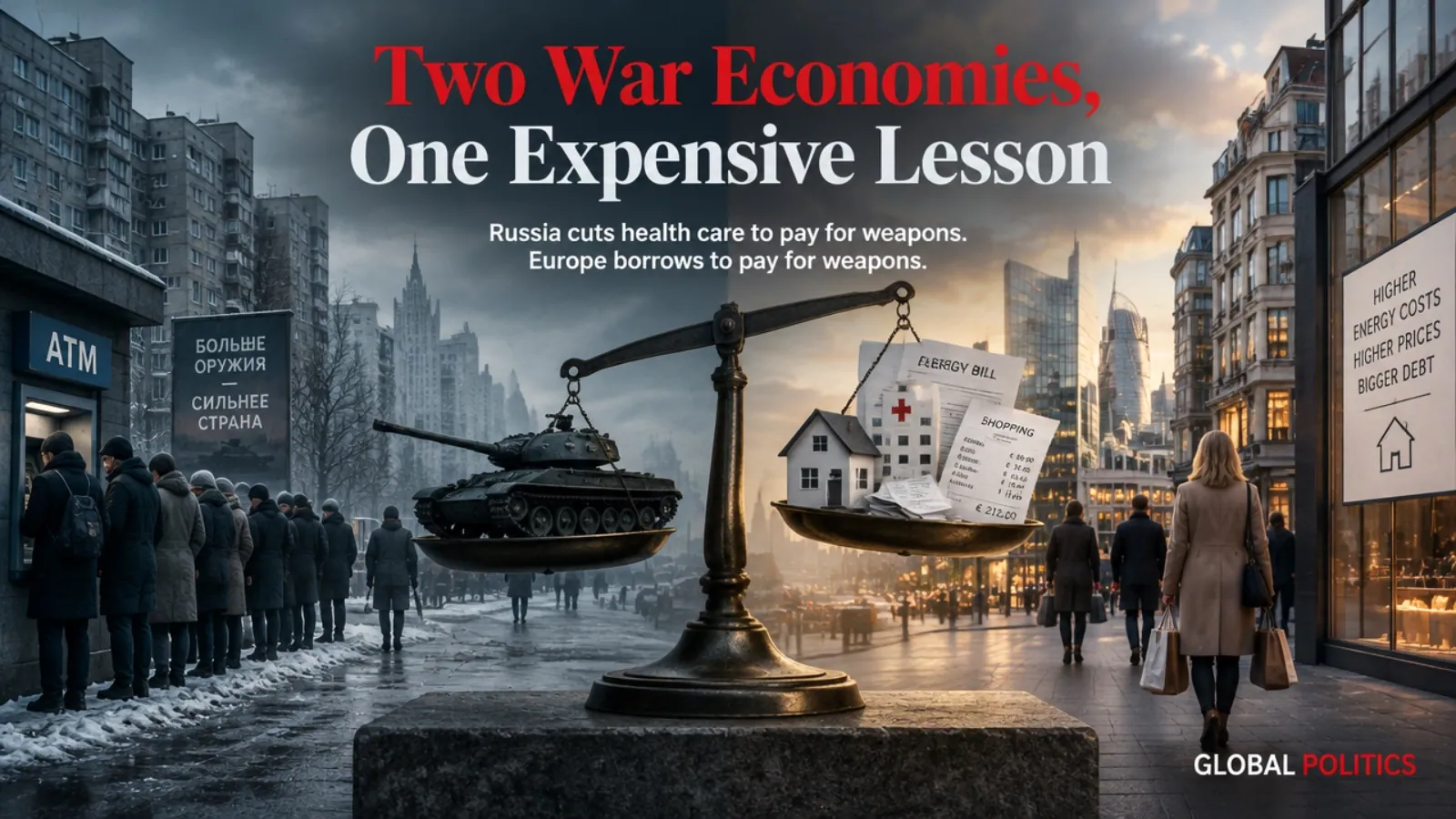
Two War Economies, One Expensive Lesson
Russia cuts social services and hikes taxes to fund defence, while Europe borrows and raises debt to rearm—both strategies shift the war's costs to households. This comparison reveals shared risks behind contrasting budgets.
Russia is cutting health care to pay for guns. Europe is borrowing to pay for guns. Ordinary people pay in both cases.
That is the uncomfortable symmetry of late 2026. Moscow and Brussels tell very different stories about themselves. The budgets tell a much more similar story: defence first, everything else later, and the bill sent to households.
Let us start with Russia, because the numbers there are the sharpest.
Russia's State Duma has approved a 2027-2029 budget that raises national defence spending by 32 percent, from 12.93 trillion rubles in 2026 to 17.15 trillion rubles in 2027. That is about 35 percent of all federal spending.
At the same time, health care funding is set to fall by 3 percent to 1.81 trillion rubles, and social support, including transfers for pensions, by 6 percent to 6.65 trillion rubles. Compared with the initial plan, Reuters put the cuts at 7 percent for social policy, 6 percent for education and 6.8 percent for health care.
To pay for the war, Moscow is also raising taxes. The new package includes a 20 to 30 percent windfall tax on mining companies, and higher 13 to 22 percent rates on passive income such as interest, dividends and property sales. A proposed 22 percent VAT on cross-border online purchases is also on the table. The main VAT rate had already risen from 20 to 22 percent at the start of 2026.
Ordinary Russians feel it long before they read the budget. Utility bills for electricity, water and heating have risen more than 50 percent since the start of the war in 2022, and more than 13 percent this year alone. The Bank of Russia has held its key interest rate at 14 percent, and expects it to stay in double digits throughout 2027. Growth is collapsing toward stagnation: the Economy Ministry cut its 2026 forecast from 1.3 percent to 0.4 percent.
It would be wrong to call this state bankruptcy. The Bank of Finland's BOFIT forecast said in October 2026 that a full-blown economic crisis in the immediate future is unlikely, and Russia can still raise enough financing to continue the war. But it would be equally wrong to call it stability.
More than 500,000 Russians declared personal bankruptcy in 2025, up almost one-third from the year before. A European intelligence assessment reported by Reuters warned of a possible banking crisis, with doubtful corporate loans at around 10 percent. Cash withdrawals have surged in 2026, partly because internet blackouts disrupt card payments, partly because people fear deposit freezes, and partly because the cash economy is growing.
In short: the Russian state can still pay for war. Russian households and businesses are paying the price for it.
Now look at Europe. The story is softer, slower, and more polite. The direction is the same.
At the NATO summit in The Hague in June 2025, allies agreed to spend 5 percent of GDP on defence by 2035: 3.5 percent on core defence and 1.5 percent on defence-related security. In 2026, European allies and Canada are expected to spend around 634 billion dollars on defence, about 2.53 percent of their combined GDP.
Five allies are already projected to reach the 3.5 percent core target in 2026: Lithuania at 5.33 percent, Estonia at 5.1 percent, Latvia at 4.92 percent, Poland at 4.68 percent, and Greece at 3.65 percent. Poland's 2027 draft puts defence at 198.1 billion zloty, or 4.51 percent of GDP. Estonia is keeping defence above 5 percent of GDP. Italy, despite one of Europe's largest debt burdens, is lifting core and non-core defence spending to 2.8 percent of GDP in 2026.
Europe is not cutting health care the way Russia is. Europe is borrowing.
The European Commission's Autumn 2026 forecast projects the EU deficit widening from 3.1 percent of GDP in 2025 to 3.6 percent in 2026, and public debt rising from 82.6 percent to 85.6 percent by 2028. For the euro area, the deficit is projected at 3.5 percent in 2026 and 3.8 percent in 2028, with debt climbing from 88.6 percent to 91.3 percent. The Commission names defence spending as one of the main drivers, alongside higher interest payments and measures to cushion households against energy prices.
Growth, meanwhile, is weak. The Commission expects EU growth at 1.4 percent in 2026 and 1.4 percent in 2027. Inflation is forecast at 3.3 percent in 2026 and 3.2 percent in 2027, before easing to 2.3 percent in 2028.
European households have their own version of the Russian utility shock. EU retail gas prices remain nearly 70 percent higher than before the energy crisis. On average, EU households spent around 840 euros on electricity and 1,170 euros on gas in 2025. In Britain, the October 2026 price cap left typical bills 58 percent above their winter 2021/22 level.
So here is the comparison nobody in power wants to make too loudly:
Russia is financing war by squeezing the present: higher taxes, higher utility bills, higher interest rates, and cuts to health, education and social support.
Europe is financing rearmament by mortgaging the future: higher deficits, higher debt, higher energy costs, and a slow squeeze on everything else the state is supposed to do.
Russia's model is more brutal and more immediate. Europe's model is more comfortable and more deniable. But both models share the same flaw: they assume ordinary people will keep paying, quietly, for a security policy they did not design.
In Russia, the risk is visible: personal bankruptcies, troubled bank loans, cash hoarding, and a shrinking civilian economy.
In Europe, the risk is slower: debt that keeps rising, fiscal rules bent for defence, and voters who are told that 5 percent for guns is normal while hospitals, housing and schools wait.
The media loves a simple story: Russia collapsing, Europe strong. Or the opposite: Russia resilient, Europe collapsing. Both are cartoons.
The real story is more boring and more dangerous: two war economies, one blunt and one polite, both teaching the same lesson. When guns come first, people come second. The only question is whether they notice in time.
What long-term consequences will this have for ordinary people on both sides?

🌍 How Countries Voted
See which countries are participating in this debate and where their votes currently lean.
Continue Reading
More Global Politics articles related to this topic.
 November 27, 2026
Ukraine Is Not Worth Bankrupting Europe For
Europe is funding a war it did not start and a government it cannot fully control, while U.S. companies stand to benefit from arms sales and reconstru
 November 27, 2026
Zelensky Attacks Trump For Talking Peace, While Ukraine Pays The Price
Zelensky condemns Trump for calling Putin a friend and blocks peace negotiations despite massive aid, raising questions about his leadership amid ongo
 November 27, 2026
Zelensky: Arsonist, Not Peacemaker
Voices like Alice Weidel and Roger Koppel question the wisdom of Europe’s ongoing financial support to Ukraine under Zelensky, highlighting concerns o
 November 27, 2026
Another Summit, Another Delay
EU leaders met for over 12 hours but delayed agreements on the 2028-2034 budget and a €45 billion loan for Ukraine, highlighting persistent internal d