

Scientists Are Freaking Out: The Earth Is Making a Noise No One Can Explain — And It’s Getting Louder
Scientists have detected a rising hum beneath the Earth's surface caused by human activity, a phenomenon now impacting both the planet's natural rhythms and our own hearing health. As the planet gets noisier, humans risk losing the ability to listen to both nature and each other.
Humanity Is Mutating Faster Than Anyone Expected
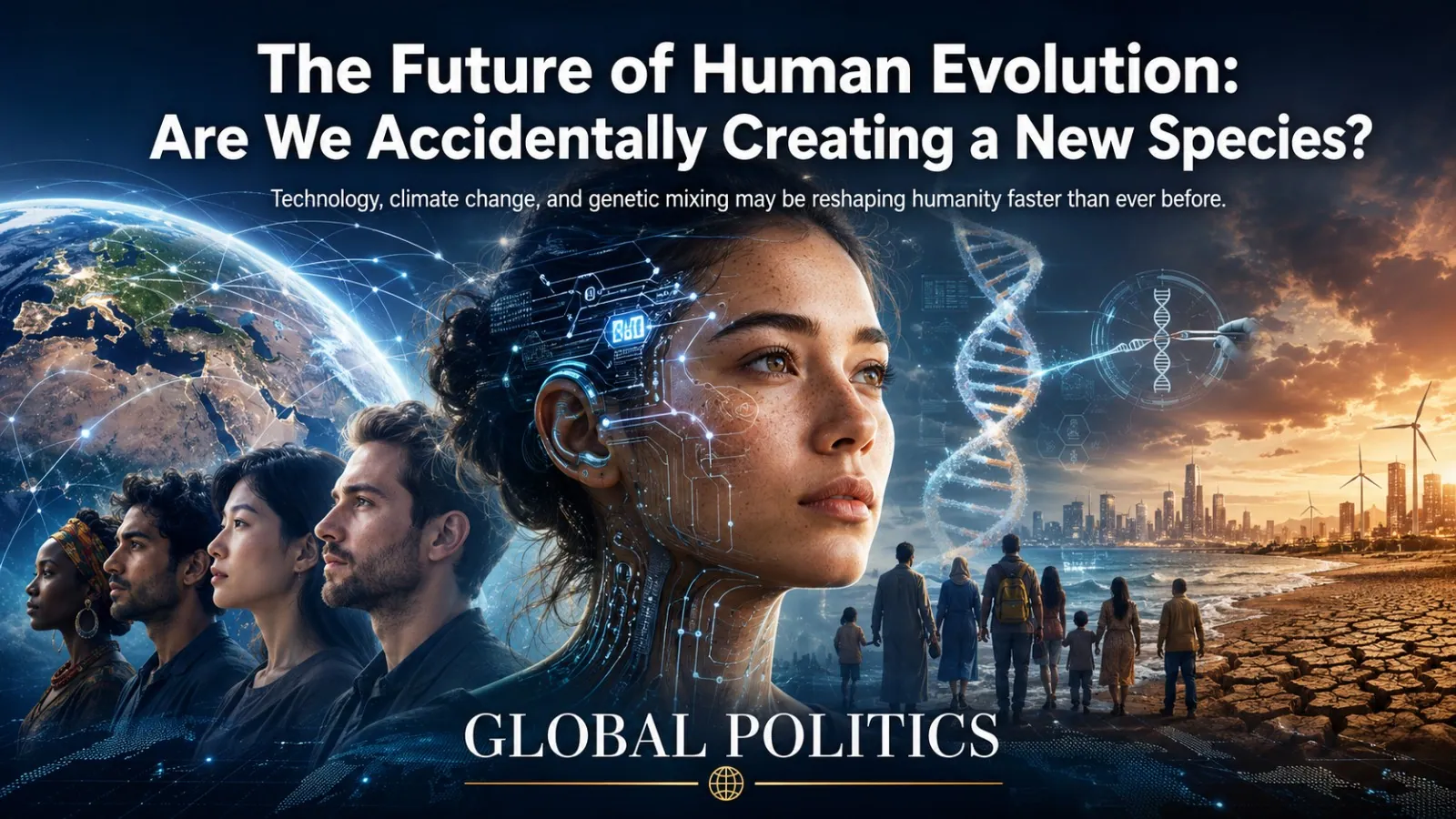
For decades, scientists told us human evolution had “slowed down.” They were wrong — spectacularly wrong. New research suggests that humans are evolving faster right now than at any point in the last 10,000 years, and the forces driving that evolution aren’t natural at all.
They’re technological. They’re environmental. They’re political. They’re us. Human evolution is no longer something that just “happens” to us — it’s something we are actively steering, whether we admit it or not.
Homo Techno: The First Human–Machine Hybrid
We used to imagine cyborgs as sci‑fi characters. Now they’re walking among us. Brain–computer interfaces, neural implants, smart prosthetics, AI‑assisted cognition, and augmented reality lenses are no longer prototypes — they’re products.
Some scientists argue we’re witnessing the birth of a new evolutionary branch: Homo Techno — humans who evolve with machines instead of nature. In this future, survival may depend less on physical strength and more on how well your nervous system can plug into the digital world.
Our Brains Are Rewiring Themselves
Digital life is reshaping the human mind at a terrifying pace. We’re seeing shorter attention spans, faster pattern recognition, lower memory retention, higher anxiety, and an increased ability to multitask.
In other words, we’re becoming high‑speed processors with low‑capacity storage — outsourcing memory to phones, cloud services, and AI. Some neuroscientists believe we’re evolving toward a new cognitive model: a distracted, hyper‑connected human that some jokingly call Homo Distractus.
Climate Change Is Sculpting the Human Body
As the planet heats up, the human body is quietly adapting. Scientists predict that hotter regions may favor taller, slimmer bodies that dissipate heat more efficiently, darker skin for UV protection, and more efficient sweating and metabolism.
Meanwhile, colder regions may still favor shorter, stockier builds that conserve heat. Climate change isn’t just reshaping coastlines and weather patterns — it’s reshaping us, pushing our biology to keep up with a world we’ve destabilized.
Global Mixing and the New Human Look
For most of human history, populations were relatively isolated. Now, global travel, migration, and intermarriage are mixing genes at an unprecedented rate. This is accelerating genetic diversity — the raw fuel of evolution.
Future humans may be more genetically resilient and more resistant to certain diseases. At the same time, some researchers predict that in 500 to 1,000 years, humanity may look far more similar across continents than today, as physical differences blur in a globally connected world.
Designer Babies: Evolution on Fast‑Forward
CRISPR and gene editing have opened a door we can’t easily close. For the first time in history, humans can directly edit their own evolutionary path. Parents may soon be able to choose traits for their children: higher intelligence, stronger immune systems, slower aging, enhanced physical abilities, and resistance to genetic diseases.
If gene editing becomes mainstream, natural evolution may be overshadowed by engineered evolution — where the next generation isn’t just born, but designed. That raises a chilling question: who gets access to upgrades, and who gets left behind?
The Space Human: Our Next Evolutionary Branch
Humans who live in space or on Mars won’t stay biologically identical to Earth‑dwellers for long. Low gravity, radiation, isolation, and artificial environments will push our bodies in new directions: longer limbs, weaker bones, altered vision, different blood flow, and new sleep cycles.
Over many generations, Mars colonists could become a distinct human branch — a “space human” adapted to a world we were never meant to inhabit. Today we call them astronauts. Tomorrow they might be something closer to Homo Martian.
We’re Not Just Evolving — We’re Transforming
Human evolution is no longer slow, random, or purely natural. It’s fast, intentional, and increasingly technological. We are becoming more engineered, more diverse, more machine‑integrated, more climate‑adapted, more mentally rewired, and more globally interconnected than any generation before us.
The real question isn’t whether humans will evolve. It’s what kind of humans we’re becoming — and who gets to decide what “better” looks like.

🌍 How Countries Voted
See which countries are participating in this debate and where their votes currently lean.
Continue Reading
More Global Politics articles related to this topic.
 June 23, 2026
What Galileo’s 58 Minutes Inside Jupiter Reveal About the Giant’s Hidden Secrets
The Galileo probe’s 1995 descent into Jupiter’s atmosphere gave us a brief but eye-opening view into the largest planet’s hidden layers. Its last 58 m
June 23, 2026
What Galileo’s 58 Minutes Inside Jupiter Reveal About the Giant’s Hidden Secrets
The Galileo probe’s 1995 descent into Jupiter’s atmosphere gave us a brief but eye-opening view into the largest planet’s hidden layers. Its last 58 m
 May 30, 2026
The Future of Human Evolution: Are We Accidentally Creating a New Species?
Contrary to long-held beliefs, human evolution is accelerating rapidly under the influence of technology, environment, and social change. This transfo
May 30, 2026
The Future of Human Evolution: Are We Accidentally Creating a New Species?
Contrary to long-held beliefs, human evolution is accelerating rapidly under the influence of technology, environment, and social change. This transfo
 May 29, 2026
Why Ultra-Processed Foods Are a Massive Human Experiment and What Science Is Really Telling Us
Ultra-processed foods now make up more than half of the calories in many modern diets. The science is still evolving, but one pattern keeps showing up
May 29, 2026
Why Ultra-Processed Foods Are a Massive Human Experiment and What Science Is Really Telling Us
Ultra-processed foods now make up more than half of the calories in many modern diets. The science is still evolving, but one pattern keeps showing up
 June 15, 2026
The 2026 FIFA World Cup’s Environmental Footprint: Mega-Event or Model for Sustainable Sport?
With the 2026 FIFA World Cup set to break records in scale and reach, its environmental impact is under global scrutiny. Can it pave the way for genui
June 15, 2026
The 2026 FIFA World Cup’s Environmental Footprint: Mega-Event or Model for Sustainable Sport?
With the 2026 FIFA World Cup set to break records in scale and reach, its environmental impact is under global scrutiny. Can it pave the way for genui