
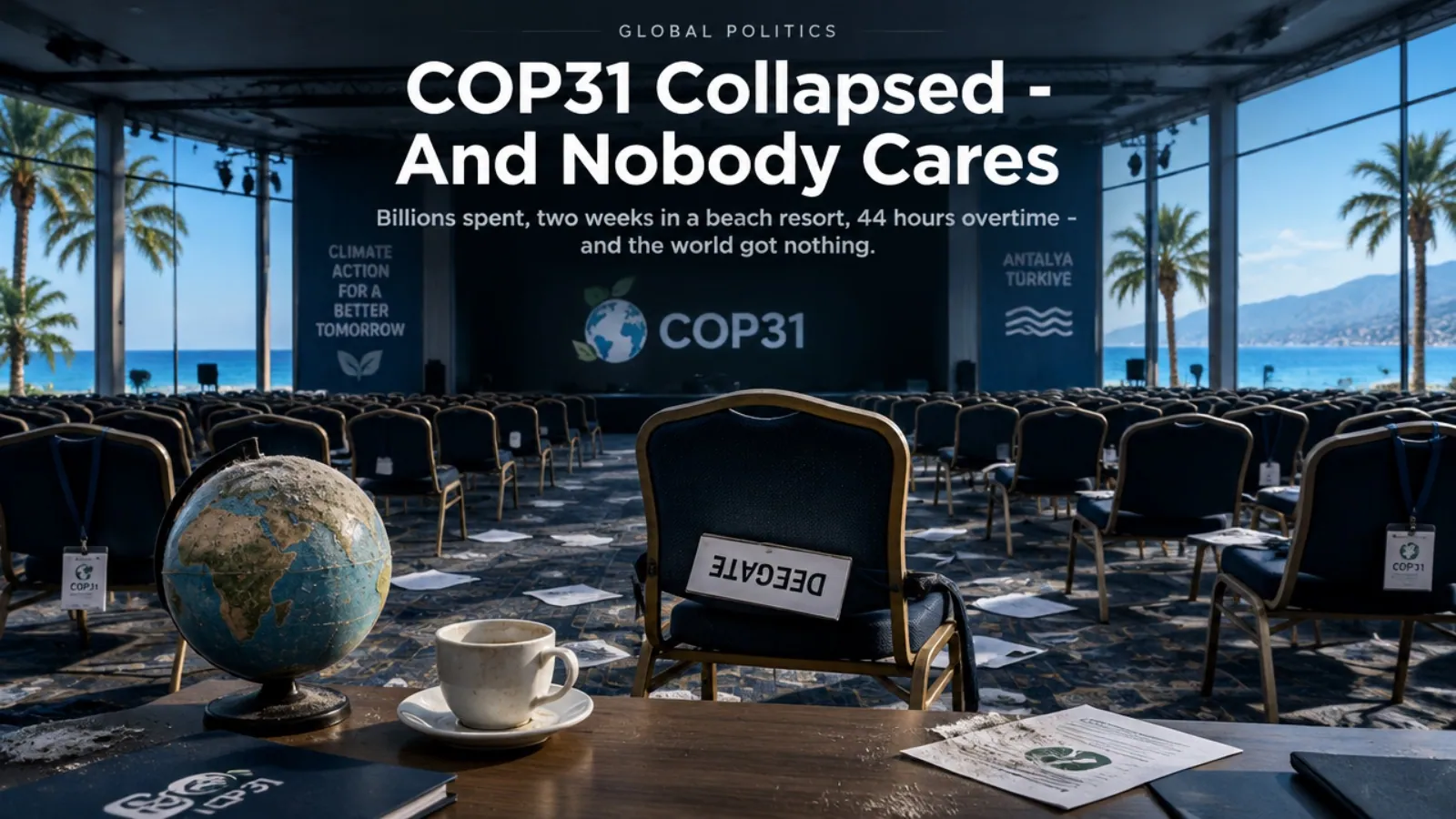
COP31 Collapsed — And Nobody Cares
COP31 ended without any concrete agreements after prolonged negotiations and historic overtime, raising doubts about the summit's ability to address urgent climate needs amid rising global temperatures.
Billions spent, two weeks in a beach resort, 44 hours overtime — and the world got nothing.
Sunday, November 22, 2026 · Antalya, Turkey · 5 min read
For two weeks, almost every country in the world sent delegates to Antalya, Turkey, a beach resort city, for COP31, the UN climate summit. They talked about saving the planet. They stayed 44 hours into overtime, the longest overtime in UN climate summit history. And on Sunday, November 22, 2026, they went home with nothing. No overarching agreement. No final deal. The first COP to fail like this since Copenhagen in 2009. Delegates called it the worst COP ever. So let us ask the question nobody in the media wants to ask: after all this money, all these flights, all these speeches, what did ordinary people actually get?
What Happened in Antalya
The breaking point was simple: fossil fuels. The draft text, called the Antalya pact, had no mention of a transition away from fossil fuels. Around 90 countries, including the EU, Norway, Panama and the Marshall Islands, rejected it. Rich countries and poor countries fought over climate finance and a just transition mechanism. The talks stretched two days into overtime, then collapsed. The World Resources Institute called it a hollow outcome and a failure of political leadership, not a failure of science. Mohamed Adow, director of Power Shift Africa, said: This has been the worst ever COP and its collapse needs to be a wake-up call for the world. He was right about one thing: it was a wake-up call. But not in the way he meant.
The Hottest Year, The Coldest Result
This happened in what will probably be the hottest year on record. That is the irony. The hotter the planet gets, the colder the result from these summits. Every year, we are told this COP is the most important ever. Every year, leaders fly in private jets to tell ordinary people to drive less, eat less, consume less. Every year, there are promises, pledges, and photos. And every year, the promises fade. COP31 was supposed to be an implementation COP, a summit to actually do things. Instead, it became one of the worst ever climate summits. If 31 summits cannot produce a deal, maybe the problem is not the text. Maybe the problem is the summit itself.
Who Pays For This Theatre
Let us talk about money, because nobody else will. Who pays for thousands of delegates, hotels, security, flights, catering, and two weeks in a beach resort? Taxpayers. Ordinary people. The farmer in Iowa who just watched the Army blow up toxic explosives near his town. The family in Ukraine trying to survive winter with energy prices rising. The worker in Africa who is told to wait for a just transition while rich countries block the mechanism to pay for it. They pay, in taxes and in higher prices, for a show that ends with no deal. And then they are told they are the problem because they do not recycle enough. Is that fair? Is that justice? Or is that a very expensive theatre where the actors get applause and the audience gets the bill?
This Is Not About Denying Climate Change
Let us be clear. This article is not saying climate change is fake. This article is saying COP31 is fake. There is a difference. Real environmental problems need real solutions: cleaner air, cleaner water, less waste, better energy. But a summit that ends with nothing after two weeks and 44 hours overtime is not a solution. It is a ritual. And rituals do not lower temperatures. They lower trust. When people see leaders fail again and again, they stop believing. And when they stop believing, they stop listening, even to good ideas. That is the real damage of COP31. It did not just fail to produce a deal. It failed to produce trust.
What Should We Ask Instead
Instead of asking which country blocked which paragraph, we should ask simpler questions. How much did COP31 cost in total, including flights, hotels, and security? Who calculated the carbon footprint of the summit itself? Why do we need 31 summits to agree on one text about fossil fuels? Why was the summit held in a beach resort, not in a place suffering from climate damage? And if the next summit, COP32 in Addis Ababa in 2027, also fails, will anyone be held responsible? These are not left or right questions. They are citizen questions. A planet in trouble deserves action, not another conference.
COP31 collapsed. The planet did not notice. Ordinary people did not notice, except in their bills. Tell us in the comments. Do you think these summits still help, or is it time to admit the COP circus has failed?
🌍 How Countries Voted
See which countries are participating in this debate and where their votes currently lean.
Continue Reading
More Global Politics articles related to this topic.
 November 28, 2026
Slogans vs. Common Sense: Why Funding War Is Not The Same As Defending Freedom
While slogans praise continued funding of the Ukraine war as brave and necessary, the reality reveals severe human, economic, and political costs that
 November 27, 2026
Zelensky Attacks Trump For Talking Peace, While Ukraine Pays The Price
Zelensky condemns Trump for calling Putin a friend and blocks peace negotiations despite massive aid, raising questions about his leadership amid ongo
 November 27, 2026
Zelensky: Arsonist, Not Peacemaker
Voices like Alice Weidel and Roger Koppel question the wisdom of Europe’s ongoing financial support to Ukraine under Zelensky, highlighting concerns o
 November 27, 2026
Ukraine Is Not Worth Bankrupting Europe For
Europe is funding a war it did not start and a government it cannot fully control, while U.S. companies stand to benefit from arms sales and reconstru