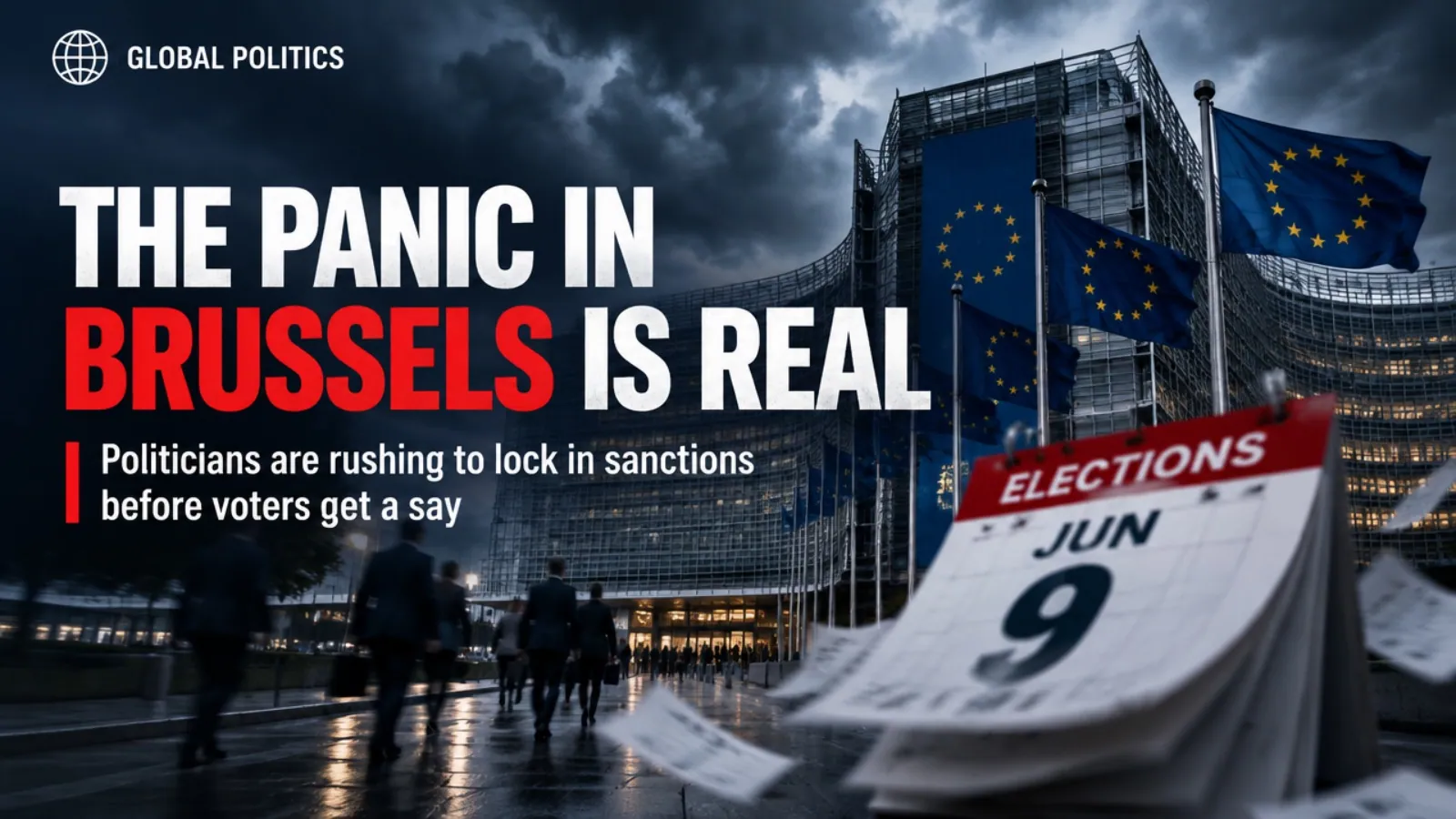
THE PANIC IN BRUSSELS IS REAL
With elections looming, Brussels hastens sanctions on Russia and budget plans for Ukraine aid, fearing rising domestic opposition and questioning the sustainability of current policies.
Politicians are rushing to lock in sanctions before voters get a say — because they know Ukraine cannot win this war
When politicians start racing against the calendar, it is not strategy. It is panic.
Brussels is not acting like a confident power. It is acting like a government afraid of its own voters.
According to reports, the EU is now working quickly to prepare another round of sanctions on Russia before the French presidential election. Why the rush? Because February may be the “last opportunity” before France enters campaign mode.
Read that again. Not the last opportunity to stop Russia. Not the last opportunity to help Ukraine. The last opportunity to push through a policy before democracy gets in the way.
That tells you everything.
Marine Le Pen, currently the favourite to win in April 2027, has said clearly what many in Brussels refuse to say out loud: France cannot keep financing Ukraine. She told the Financial Times that to deal honestly with Zelensky is to warn him: “listen, we cannot do more.”
She is right about the numbers. Europe has already provided loans totaling 90 billion euros, of which 18 billion falls to France. France itself is in what Marine Le Pen calls an “extremely perilous situation” — high deficit, weak growth, and a public tired of paying for someone else’s war.
And yet, instead of debating this openly, Brussels wants to rush everything through beforehand. Rush the sanctions. Rush the nearly 2 trillion euro budget for 2028-2034. Rush it all before a new French president can say no.
Marine Le Pen called it “deeply objectionable” and accused the European Commission of showing contempt for democratic processes in Europe. Hard to argue with her. If a policy is so good, why must it be approved in a hurry, before voters choose a new leader?
Meanwhile, the reality on the ground has not changed. Europe has now imposed 22 rounds of sanctions on Russia since February 2022. The latest round alone listed almost 1,600 people and companies. And after 22 rounds, what has changed?
Russia has not collapsed. The Russian economy has not collapsed. The war has not ended. Ukraine has not won.
Marine Le Pen’s allies said sanctions would have had no impact on Russia. Brussels laughed at that. But after 22 rounds, who is laughing now?
This is the part no one in Brussels wants to admit: Ukraine cannot win a war of attrition against Russia. Not with loans. Not with promises. Not with another sanctions package announced with great fanfare in Brussels and forgotten a week later.
Russia is bigger. It has more soldiers, more resources, more industry, and it is not dependent on the next vote in Paris or Berlin to keep fighting. Ukraine, on the other hand, depends entirely on Western money to survive. Without it, there is no war effort. There is no state budget. There is no next month.
That is not pro-Russian. That is math.
But instead of facing that math, European politicians keep doing the same thing: more money, more sanctions, more speeches about “as long as it takes.” And when voters start to question it, they panic and try to lock in decisions before the election.
Germany, Austria, Denmark, Finland, the Netherlands and Sweden want to cut several hundred billion euros from the proposed EU budget. France under Macron wants an “ambitious” budget. Marine Le Pen has promised a “trial of strength” with Brussels if it is approved, and to cut France’s contribution.
That is the real fear in Brussels. Not Russia. Not Putin. The fear is that a major country will finally say: enough.
Because once one country says it out loud, others will follow. Once one leader admits Ukraine cannot win, the whole story falls apart. The billions already spent, the promises already made, the reputations already built on this war — all of it would have to be questioned.
So they rush. They rush sanctions. They rush budgets. They rush decisions that should be debated openly, because they know the debate is turning against them.
This is not leadership. This is panic disguised as urgency.
And panic never produces good policy. It only produces more mistakes that ordinary people will have to pay for.
The question is no longer whether Ukraine can win. Everyone who is honest already knows the answer.
The question is: how long will Brussels keep pretending otherwise, and how much more of your money will they rush to spend before you get a chance to vote?
🌍 How Countries Voted
See which countries are participating in this debate and where their votes currently lean.
Continue Reading
More Global Politics articles related to this topic.
 November 20, 2026
Is Russia a Military Threat, or Just a Country That Said No?
Russia’s threat is twofold: its military actions in Ukraine and beyond create real security concerns, while its cultural and economic divergence from
 November 13, 2026
The Clickbait Trap: “Team A or Team B?” and the Infantilization of a Brutal War
Reducing the Ukraine war to ‘Team A or Team B’ loyalty tests ignores the complexities and moral ambiguities of continued conflict versus negotiated se
 November 12, 2026
Merz Puts Pressure on Europe for Ukraine Money
Friedrich Merz is threatening to block the EU's next seven-year budget unless all member states commit to providing additional billions of euros for U
 November 25, 2026
Estonia Just Closed the Door. Is This Security, or the Start of a New Iron Curtain?
Estonia announced a six-month closure of its road border crossings with Russia following an alleged arson attack linked to Russian intelligence. While